
More Information about Our Processes
There are many different processes for making rose petal rosary beads, most of which involve boiling a large number of petals and mixing them with various organic ingredients. We do it a little differently because we not only wish to preserve the flowers, but want to make sure that the finished bead is going to last as long as possible. We chop and then grind the dried petals down, gently knead the rose powder into the chosen clay, hand-roll the beads to 8mm each and fire them (unglazed) in a kiln. This creates strong, ceramic beads that contain the essence and elements of the original petals, thereby preserving the memory for a lifetime. Alternatively, we can use polymer clay. Both materials are excellent, but each has its advantages and disadvantages:
 Bead Strength
Both materials are very strong. The ceramic clay beads are rigid like small stones, where the polymer beads have a degree of flexibility and resiliance. Both can be broken if purposefully attempted - with a hammer, for example - but common actions like an accidental drop or placing something heavy on top them is not going to cause any damage to the beads. Nor will an accidental trip through the washing machine - something that would destroy organic beads. In normal use, it is unlikely that an individual bead will ever experience more than about 5 pounds of force. In our testing, 200 pounds of direct pressure had no visible effect upon the ceramic bead. The same 200 pounds caused the polymer bead to deform and begin to crack (at lower pressures it was fine).
Speed
It takes just about the same length of time regardless of the clay used. They both require similar working, mixing, rolling, pinning and firing. Though the firing process is longer for ceramic clay, it does not significantly-affect the overall rosary-making process.
Smell
Rose beads do not naturally have any fragrance. Regardless of the bead-making method used, the rose-odor must be added to the beads after the firing process (even with almost all organic processes, too). We do this using rose oil, and usually omit this unless it is specifically requested so as to avoid allergy problems or situations where people don't care for the particular perfume or oil used. If you ever wish to add more "smell" to the beads, rose-fragrance oil is available at many craft shops; keeping the beads with a sachet will have a similar effect.
Cost
The cost to make the clay beads, themselves, is the same whether they are ceramic or polymer, about $50 for a typical rosary. Add the labor to then assemble the rosary, plus the cost of the other parts, and most rosaries made with real roses start around $75. We offer discounts of 10% or more for large orders in which we can make the clay in a single, large batch.
Which is better?
It is purely a matter of personal taste. However, if the rosary is likely to be kept in a pocket or purse, if you want to be able to see the flower particles in the clay, or if you would like a stronger, non-pastel color, then we recommend polymer clay instead of ceramic for reasons mentioned above. We usually use polymer clay unless you specifically request otherwise.
Bead Strength
Both materials are very strong. The ceramic clay beads are rigid like small stones, where the polymer beads have a degree of flexibility and resiliance. Both can be broken if purposefully attempted - with a hammer, for example - but common actions like an accidental drop or placing something heavy on top them is not going to cause any damage to the beads. Nor will an accidental trip through the washing machine - something that would destroy organic beads. In normal use, it is unlikely that an individual bead will ever experience more than about 5 pounds of force. In our testing, 200 pounds of direct pressure had no visible effect upon the ceramic bead. The same 200 pounds caused the polymer bead to deform and begin to crack (at lower pressures it was fine).
Speed
It takes just about the same length of time regardless of the clay used. They both require similar working, mixing, rolling, pinning and firing. Though the firing process is longer for ceramic clay, it does not significantly-affect the overall rosary-making process.
Smell
Rose beads do not naturally have any fragrance. Regardless of the bead-making method used, the rose-odor must be added to the beads after the firing process (even with almost all organic processes, too). We do this using rose oil, and usually omit this unless it is specifically requested so as to avoid allergy problems or situations where people don't care for the particular perfume or oil used. If you ever wish to add more "smell" to the beads, rose-fragrance oil is available at many craft shops; keeping the beads with a sachet will have a similar effect.
Cost
The cost to make the clay beads, themselves, is the same whether they are ceramic or polymer, about $50 for a typical rosary. Add the labor to then assemble the rosary, plus the cost of the other parts, and most rosaries made with real roses start around $75. We offer discounts of 10% or more for large orders in which we can make the clay in a single, large batch.
Which is better?
It is purely a matter of personal taste. However, if the rosary is likely to be kept in a pocket or purse, if you want to be able to see the flower particles in the clay, or if you would like a stronger, non-pastel color, then we recommend polymer clay instead of ceramic for reasons mentioned above. We usually use polymer clay unless you specifically request otherwise.
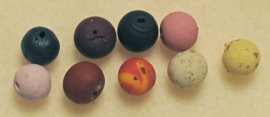
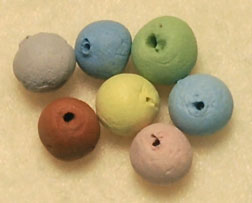
Close-up Image of Sample Beads
Polymer clay beads are available in almost any color, even mixed/swirled colors. They are smoother and the rose petal particles are visible in the clay.
Ceramic clay beads are available in pastel colors, white and terra cotta. They generally have a rough exterior.
How to Order
- Try our fancy new, or
If ordering the beads alone or a small chaplet like a bracelet, there is a minimum charge of $25 for making the beads. If the online ordering system seems too complicated or confusing, please feel free to simply mail your roses to us along with a note describing your order. See the questions, below, for a list of the information we need.
After Ordering...
Once you place your order, please send your dried rose petals to us in a padded paper envelope (the petals are easily dried on a tray in an oven set to low heat). Our address is at the bottom of every web page. We will need at least the petals from one entire flower for each set of rosary beads. If you wish to send more, that is fine, but one will be enough (even a single petal is sufficient if that is all you have, as the bulk of the bead is clay). Please do not send them in a sealed plastic bag - any residual moisture can lead to mold.
If you have any last-minute, special requests about the rosary, it is usually best just to include them in writing with the flowers.
Please allow 2 weeks from the time we receive your rose petals for us to make the beads - up to 4 weeks if we are also making a rosary with them. Do not be alarmed if we do not use all of the roses that you send. It is important that we do not weaken the clay by adding too many rosepetals.
Common Questions
How do I preserve the flowers? It is best for us if they arrive already dried. They do not need to be on the stem. We remove the petals from the stem anyway and use only the petals in the clay. It is easy to dry petals by removing them from the stem, laying them on a cookie sheet and warming them on low heat in an oven, or by setting them in the sun for a few days.
RELATED VIDEO

Share this Post
latest post
-
 Handmade beaded Earrings August 30, 2026
 -
 Creative Jewelry making ideas August 10, 2026
 -
 Handmade paper beads July 21, 2026
 -
 Who makes Pandora Jewelry? July 1, 2026
 -
 Fabric beads · How To make? June 11, 2026
 -
 Custom Handmade beaded jewelry May 22, 2026
 -
 Handmade Rosary beads May 2, 2026
 -
 Things to make with beads April 12, 2026
 -
 Easy to make Beaded bracelets March 23, 2026